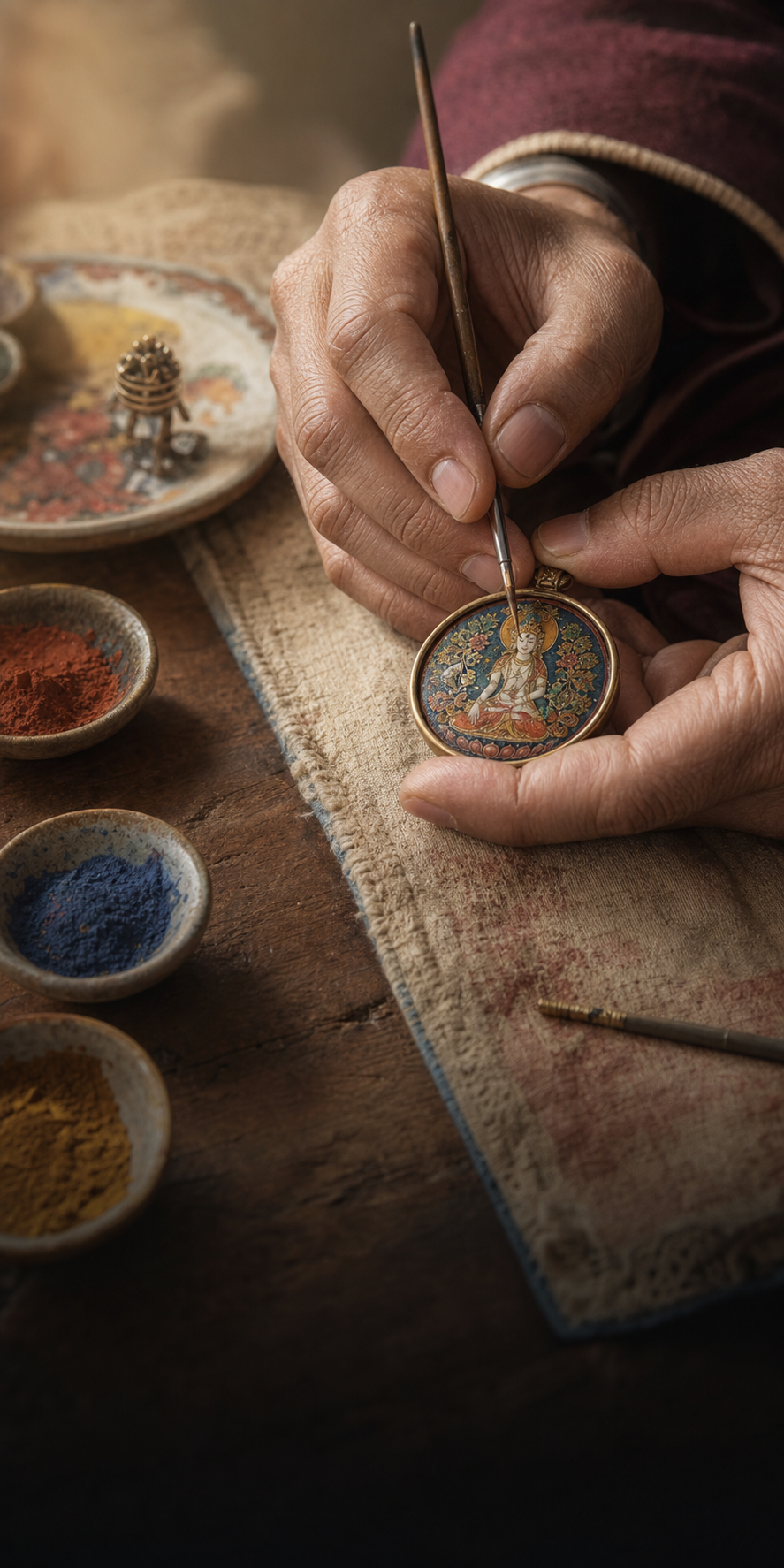
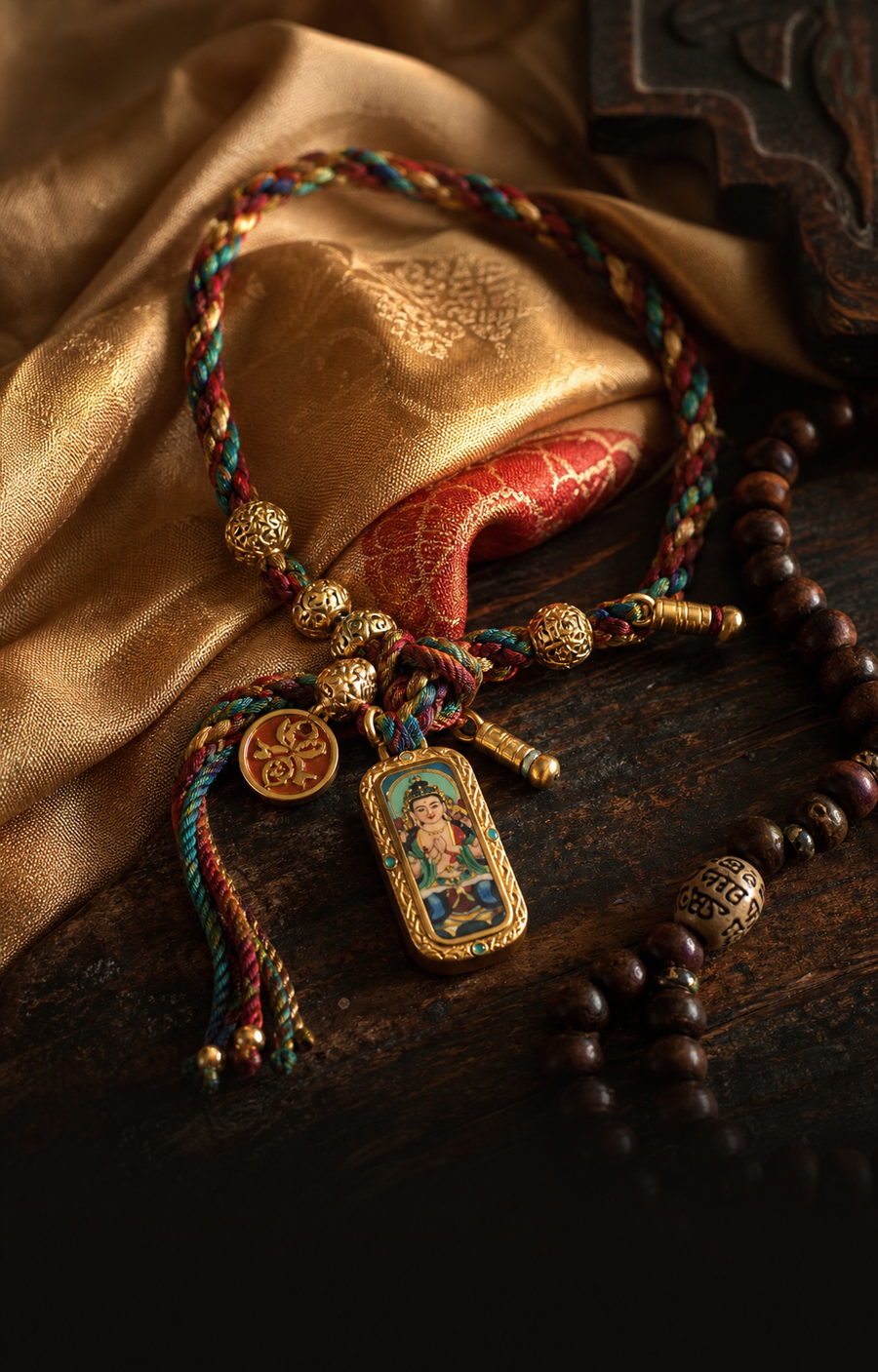
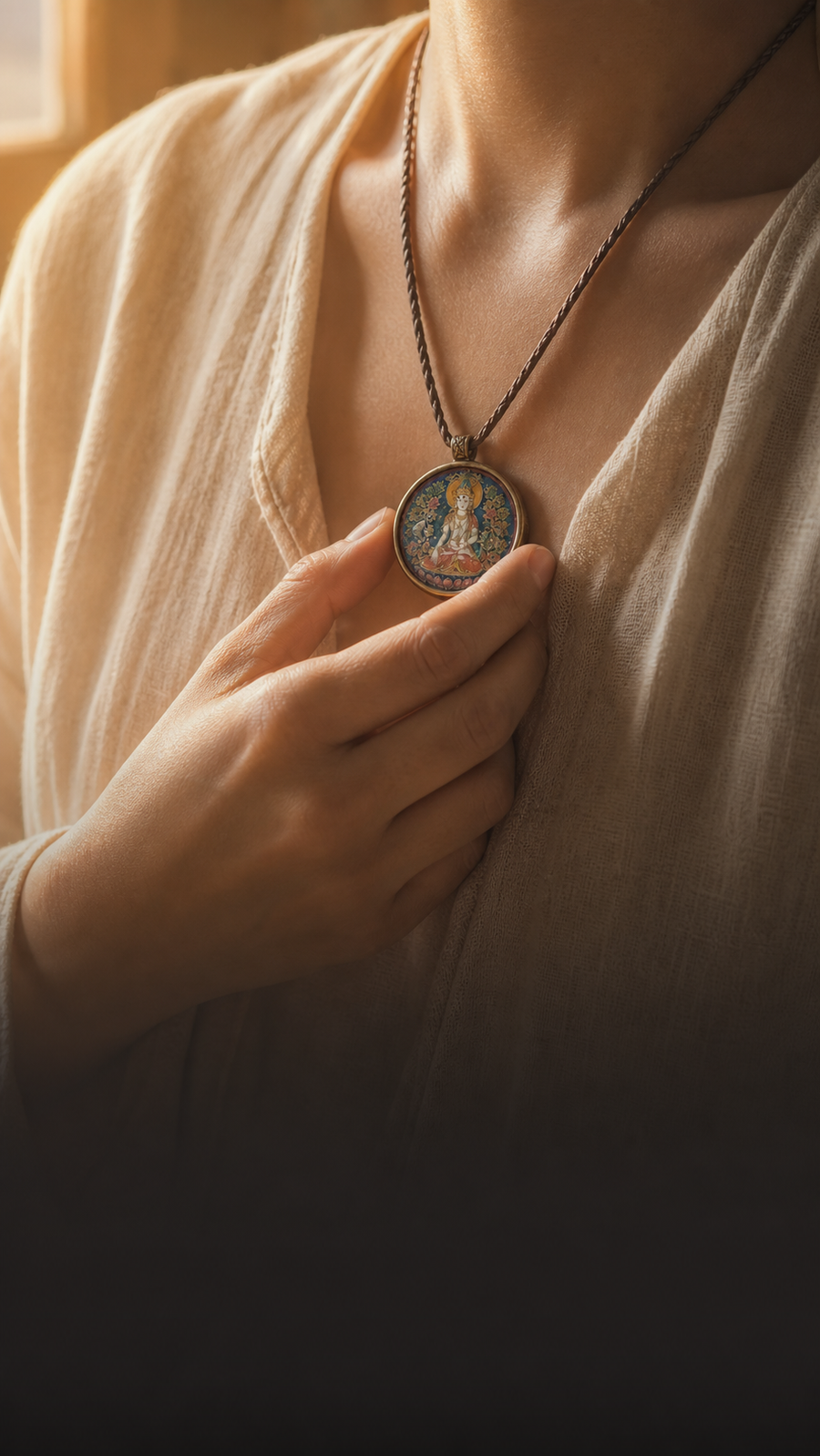
Four hands, but the first two do not reach outward. They meet at the heart. Only after compassion finds its center do the other hands extend into the world. That arrangement makes Four-Armed Avalokiteshvara one of Buddhist art’s clearest maps of compassionate action.
Who is Avalokiteshvara?
Avalokiteshvara is the bodhisattva of compassion, known across Asia under names including Chenrezig in Tibet and Guanyin in China. His Sanskrit name is often interpreted as ‘the lord who looks down’—not in judgment, but to hear and witness the cries of the world. Early Indian texts and art gave rise to many forms, which changed as his devotion traveled. He may appear with two arms, four arms, eleven faces, a thousand arms, or in female form in East Asia.
The four-armed form became especially beloved in Tibetan Buddhism. Peaceful, white, and seated in meditation, he embodies compassion joined with wisdom rather than emotion alone.
The legend of the shattered vow
A famous Tibetan story tells that Avalokiteshvara vowed never to rest until all beings were free from suffering. Looking again at the world and seeing that suffering remained immeasurable, he fell into despair and his body shattered. Amitabha Buddha restored him with eleven heads so he could see in every direction and a thousand arms so he could help more beings.
That tale belongs most visibly to the thousand-armed form, yet it illuminates the four-armed image too. Compassion is not the fantasy that one person can fix everything. It is the willingness to expand one’s capacity, accept help, and begin again after the heart breaks.

What the four hands mean
The central pair joins at the heart, sometimes holding a wish-fulfilling jewel. The outer right hand holds prayer beads, suggesting continuous compassionate practice—one bead and one being at a time. The outer left holds a lotus, the familiar symbol of clarity growing from difficult conditions. Interpretations vary, but the four arms are often connected with compassion extending toward all directions and all beings.
A small image of Amitabha may appear in his crown, acknowledging Avalokiteshvara’s spiritual lineage. His white color communicates peaceful activity and openness.
What blessings are associated with Avalokiteshvara?
He is traditionally associated with compassion, protection, patience, loving speech, and freedom from fear. Devotees cultivate his qualities through prayer and the widely known six-syllable mantra. For a modern wearer, his image can become a pause before reacting: Can I listen more carefully? Can kindness include a boundary? Can I help without imagining I must do everything alone?
Who might wear him?
This symbol resonates with caregivers, parents, counselors, teachers, medical workers, and anyone trying to remain tender in a demanding world. It is also a reminder for people learning self-compassion. The heart at the center is not selfish; it is what keeps the reaching hands from becoming empty.
Cultural note: this introduction summarizes a living religious tradition. A pendant is a reminder of compassion, not a guarantee of protection.
Carry This Symbol
Explore pieces featuring the figure from this story.
 Four-Armed Avalokiteshvara — Hand-Painted Thangka Pendant, Full Color (2D)
 Four-Armed Avalokiteshvara — Mini Tibetan Thangka Pendant (3D Relief)
 Four-Armed Avalokiteshvara — Titanium Steel Pendant Necklace (2D)
Wear the Symbol
Shop every Four-Armed Avalokiteshvara piece
 Four-Armed Avalokiteshvara — Mini Tibetan Thangka Pendant (2D)$12.99
 Four-Armed Avalokiteshvara — Titanium Steel Pendant Necklace (2D)$20.99
 Four-Armed Avalokiteshvara — Hand-Painted Thangka Pendant, Full Color (2D)$49.99
 Four-Armed Avalokiteshvara — Hand-Painted Tsatsa Thangka Pendant, Deluxe (3D Relief)$49.99