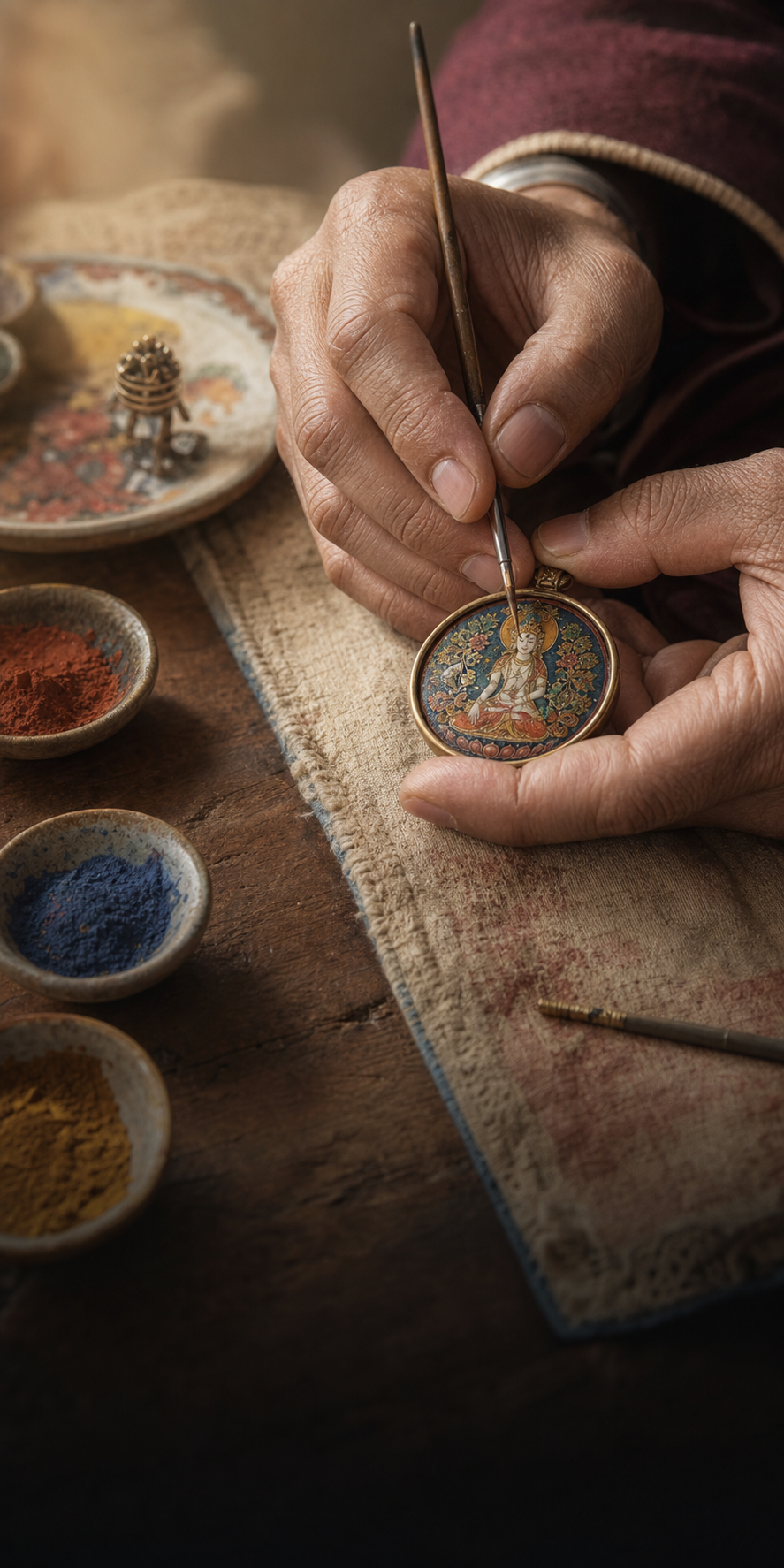
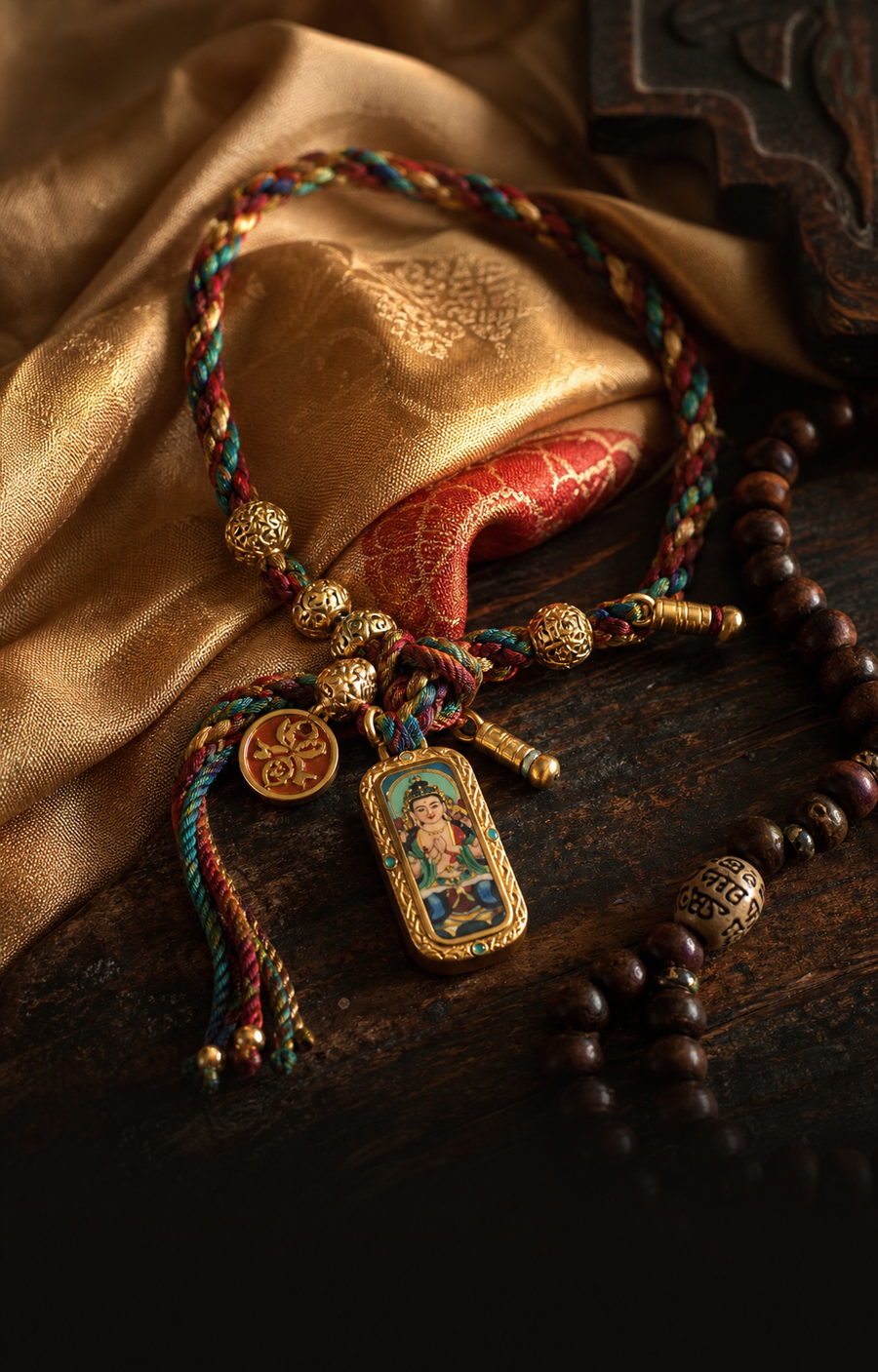
Each hand-painted Thangka pendant we carry depicts a specific guardian deity from Tibetan Buddhist tradition — not a generic symbol, but a figure with a distinct role and story. Some are invoked for protection, some for wealth, some for wisdom, some for healing. Here's a fuller guide to who's who across our collection, organized by what each one is traditionally called on for. (You can also browse by these same categories from our Find Your Blessing page.)
Compassion

Green Tara is an active, swift-acting protector — traditionally invoked to clear obstacles and calm fear in the moment, not after the fact. Her seated-but-ready posture, with one leg extended, reflects that she's always prepared to act.

White Tara is Tara's gentler, fully seated, meditative form — associated with healing, calm, and long life rather than urgent protection.

Four-Armed Avalokiteshvara (Chenrezig) is Tibet's patron deity of compassion. The four arms represent compassion carried into everyday, balanced action — pacifying, increasing, magnetizing, and subjugating.

Thousand-Armed Avalokiteshvara is the same bodhisattva's boundless form — compassion at universal scale, with an eye in each palm said to let them see and help countless beings at once.
Wealth

Yellow Jambhala is the most widely invoked wealth deity in Tibetan Buddhism — tied to abundance and generosity, not just accumulation. He's considered the "default" choice for prosperity.

Vajra Black Wealth Deity (Black Jambhala) is a fiercer emanation, traditionally called on to clear financial obstacles and debt specifically, rather than to attract more wealth in general.

Wuye is a distinct Chinese folk deity from Wutai Shan — sometimes called the "Dragon King's Fifth Son" — worshipped specifically for business fortune. He's a separate tradition from the Jambhala wealth deities, not another name for the same figure.
Wisdom

Manjushri is the bodhisattva of wisdom — the traditional patron of students and scholars, invoked for clarity of mind, insight, and exam success.

Samantabhadra represents "great vows" — putting wisdom into practice through right action and conduct, rather than wisdom held in the abstract.

Mahasthamaprapta represents the power of wisdom — part of the triad with Amitabha Buddha and Avalokiteshvara that guides beings toward liberation.
Protection

Palden Lhamo is the sole female protector deity in the Tibetan pantheon — traditionally the guardian of the Dalai Lama's lineage, and invoked more broadly for family and lineage protection.
Mahakala ("the Great Black One") is a wrathful Dharma protector — invoked for fierce, active removal of obstacles on the spiritual path. (Not currently part of our pendant lineup, but part of the tradition worth knowing.)

Ksitigarbha is gentle where other protectors are fierce — vowed to look after children, travelers, and the departed.

Wisdom Eyes aren't a deity at all, but the all-seeing Buddha Eyes seen atop the Boudhanath Stupa in Nepal — a symbol of omniscience, watching over all four directions at once.
Healing

Medicine Buddha is invoked specifically for physical and mental healing — a figure to carry through illness or difficult seasons.
Destiny & the Zodiac Guardians

Vairocana Buddha, one of the Five Dhyani Buddhas, represents illumination and clarity in this life — distinct from Amitabha's focus on the next.

Amitabha Buddha is tied to infinite light and guiding souls toward rebirth in the Pure Land — a figure more associated with the afterlife and longevity than present-day clarity.

Past & Present Life designs draw on the Chinese benming fo (本命佛) tradition, where each birth-year zodiac sign has its own assigned guardian carried across incarnations: Rat with Thousand-Armed Avalokiteshvara, Rabbit with Manjushri, Dragon and Snake with Samantabhadra, Horse with Mahasthamaprapta, Sheep and Monkey with Vairocana Buddha, and Dog and Pig with Amitabha Buddha.
When you choose a Thangka pendant, you're not just choosing a design — you're choosing which figure you want close to you. Every piece is individually hand-painted by Tibetan artisans, which is part of why no two are ever quite identical. Ordering from our Customize collection? You can also personalize the back with a name, date, or short phrase.