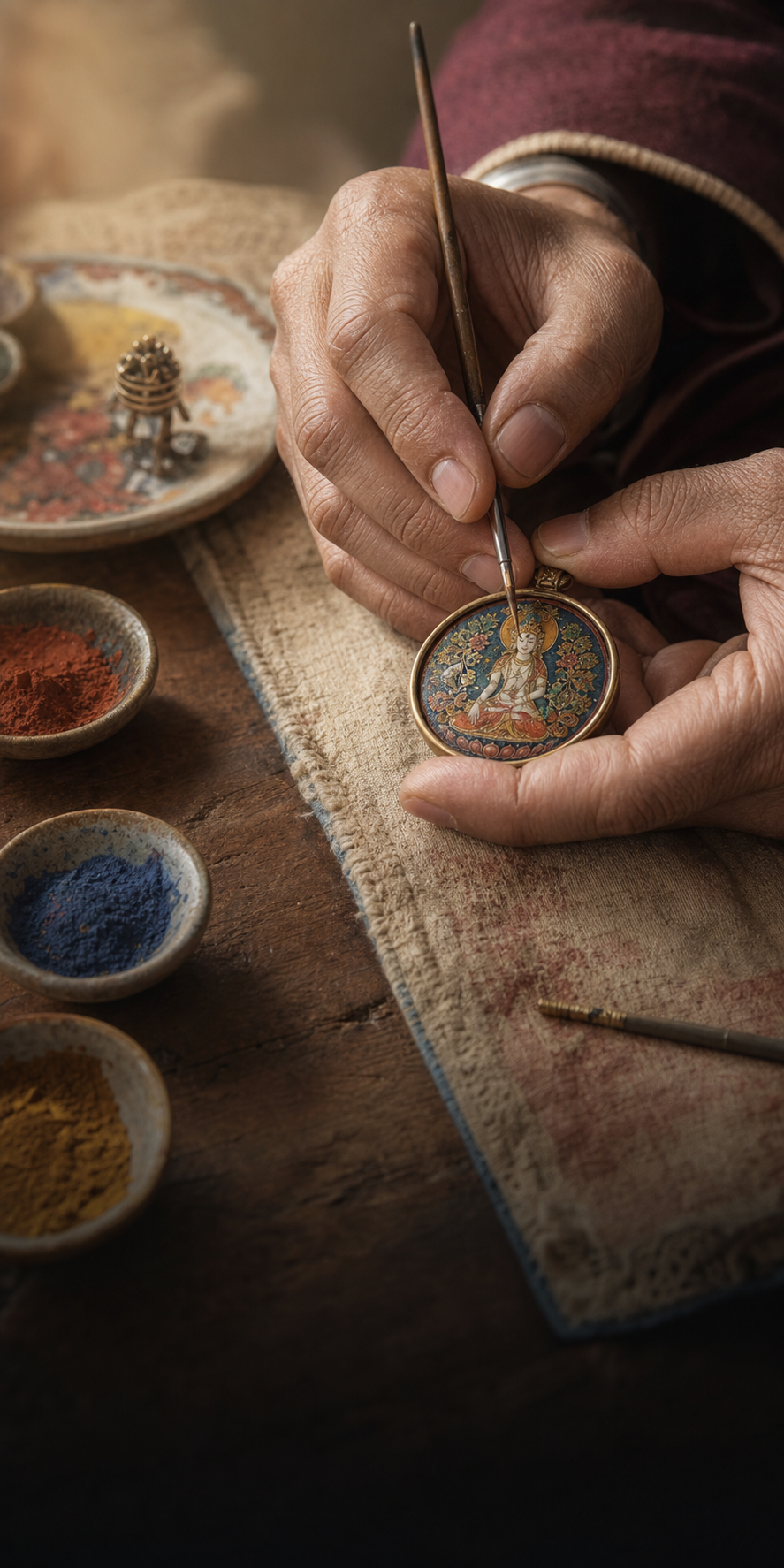
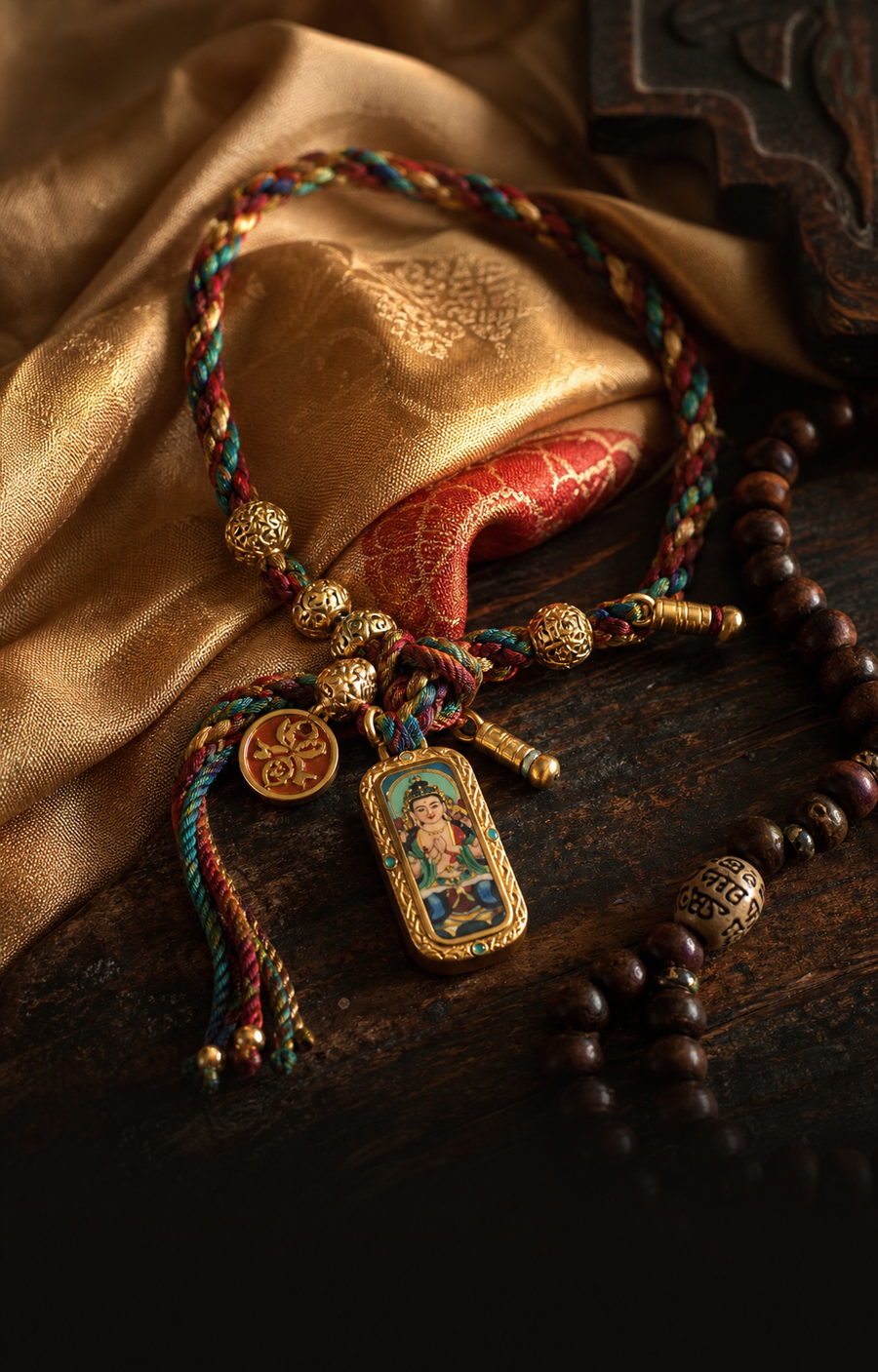
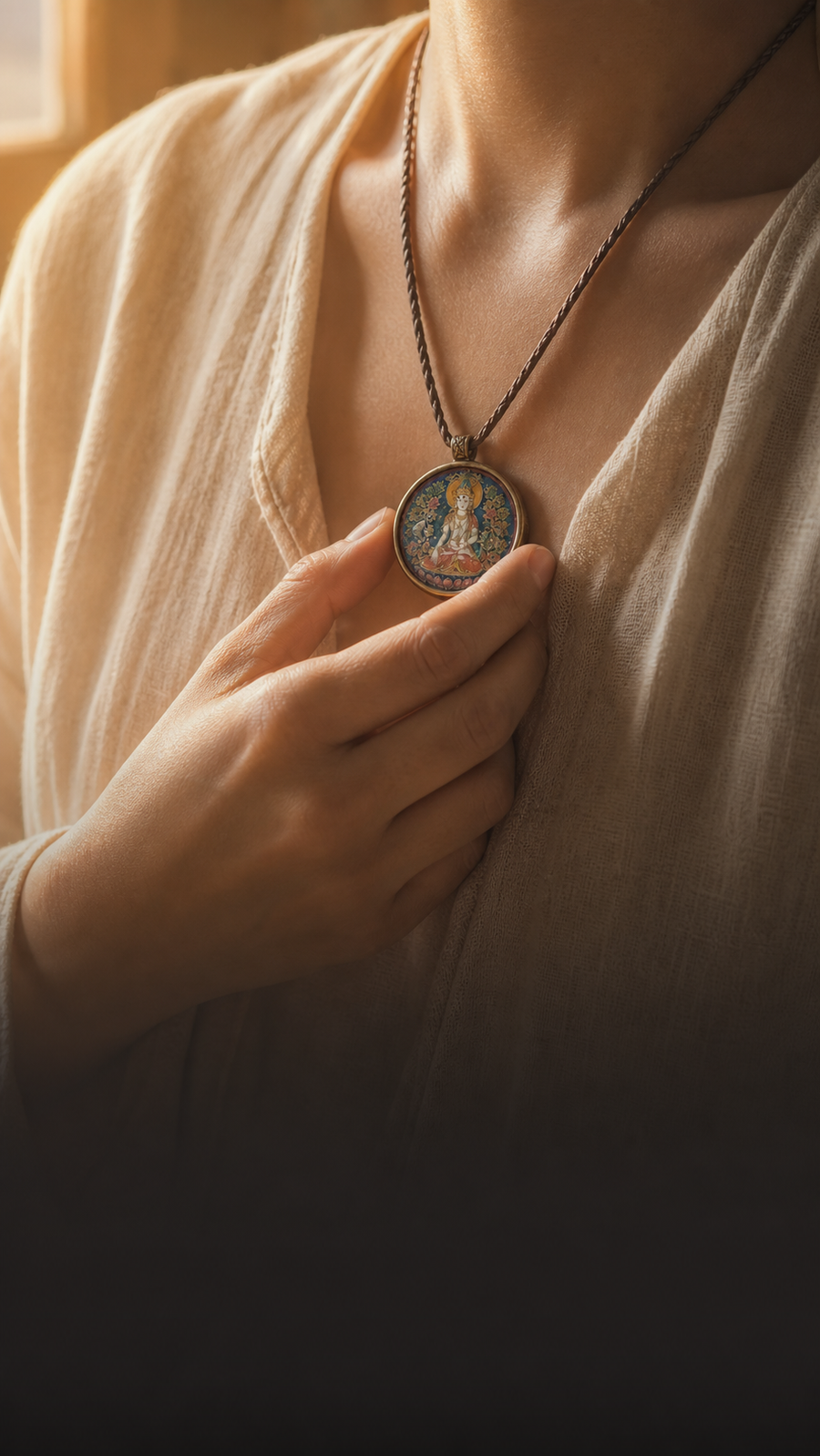
A cord does more than hold a pendant. Shape, thickness, length, color, and texture decide whether the finished necklace feels minimal, ceremonial, grounded, or easy enough for every day.
Round and oval pendants
Curved silhouettes feel soft and balanced. They sit naturally on bead strands and look especially good with cords that repeat the round rhythm through knots or small beads. Keep the cord slightly quieter if the frame is ornate.
 Mini Round Wuye — Hand-Painted Tsatsa Relief Thangka PendantView pendant →
 Green Tara — Hand-Painted Tibetan Thangka Pendant (3D Relief)View pendant →
Square and rectangular pendants
Straight-edged frames feel graphic and architectural. They pair well with clean woven cords, slim chains, and simple bead arrangements. A rectangular pendant usually needs a little more vertical space, so medium or longer lengths prevent it from crowding the neckline.
 Four-Armed Avalokiteshvara — Titanium Steel Pendant Necklace (2D)View pendant →
 Past & Present Life — Titanium Steel Pendant Necklace (2D)View pendant →
Relief and deluxe shapes
Deeper relief pendants carry more visual and physical weight. Use a cord substantial enough to support the bail and frame. Decorative knots or gemstone beads can balance that depth, but leave a plain section near the pendant so the painting remains the focus.
 Vairocana Buddha — Hand-Painted Tsatsa Thangka Pendant, Deluxe (3D Relief)View pendant →
 Palden Lhamo — Hand-Painted Tsatsa Thangka Pendant, Deluxe (3D Relief)View pendant →
Mini pendants
Mini forms are easiest for everyday wear and layering. A slim cord keeps their scale intentional; an oversized bead strand can make them disappear. They are also the most comfortable choice when you prefer the symbol to feel personal rather than immediately noticeable.
 Manjushri — Mini Tibetan Thangka Pendant (3D Relief)View pendant →
 Amitabha Buddha — Mini Tibetan Thangka Pendant (3D Relief)View pendant →
Choosing the cord
Start with the bail opening—the cord’s widest fixed end must pass through it. Then match visual weight. Blue emphasizes lapis and turquoise painting; rust red warms gold frames; black calms a colorful image; natural brown makes the result more earthy.
 Handwoven Tibetan Pendant Cord — Tibetan BlueView pendant →
 Lapis Lazuli Universal Cord, Vintage StyleView pendant →
 Minimalist Universal Pendant CordView pendant →
When to add beads
Small, evenly spaced beads keep attention on the pendant. Larger crystal or stone strands turn the necklace into a fuller statement. If both parts are ornate, create breathing room with a short plain section beside the bail.
 Faceted Crystal Bead Cord, 8mm — Style TwoView pendant →
 Hand-Braided Lapis Lazuli Pendant CordView pendant →
 Natural Ebony & Beeswax Amber Pendant ChainView pendant →
A quick pairing formula
- Mini pendant: slim adjustable cord.
- Round or oval pendant: knotted cord or small repeating beads.
- Square or rectangular pendant: simple cord at medium length.
- Heavy relief pendant: stronger woven cord with a secure, measured opening.
- Colorful pendant: repeat one color; do not match every color.
Styling note: Measure the bail and the cord end before ordering. The flexible cord may fit while a fixed bead cap, clasp, or decorative knot does not.
Styling succeeds when the pendant still feels like the focal point. The cord should make the symbol easier to wear—not turn it into something too complicated to leave the jewelry box.