Of all the figures in the Buddhist pantheon, few have captured the imagination quite like Green Tara. She is instantly recognizable — seated in a half-lotus posture with her right foot extended, ready to rise at a moment's notice. Her expression is calm but her posture says something else entirely: I am here, and I am ready.

This duality — stillness and motion, contemplation and action — is at the heart of what makes Green Tara one of the most beloved deities in the Himalayan tradition. She is the embodiment of active compassion, the kind that does not just feel sympathy from a distance but gets up and does something about it.
Who Is Green Tara?
Green Tara — known as Syamatara in Sanskrit and Drolma in Tibetan — is a female bodhisattva, an enlightened being who has chosen to remain in the cycle of rebirth to help all beings reach liberation. In Tibetan Buddhism, she is regarded as the mother of all Buddhas and the swift protector who answers calls for help without delay.
She belongs to a family of twenty-one Taras, each with a distinct color and role, but Green Tara is the central figure from whom the others emanate. She is considered the original Tara — the source. While White Tara is associated with long life and healing, Green Taras domain is action itself. She is the one you turn to when you need help right now.
The earliest references to Tara appear in Indian Buddhist texts from the 6th and 7th centuries. By the 8th century, her worship had spread to Tibet, where she became so deeply woven into daily life that kings and commoners alike invoked her name. She was not a distant figure — she was a presence.
The Legend: Born from a Tear
The most widely told legend traces Green Taras origin to Avalokiteshvara, the bodhisattva of compassion. When Avalokiteshvara looked upon the suffering of the world, he wept. From one of his tears a lotus bloomed, and from that lotus emerged Tara — a being of pure compassion born to help.
In another version, she was once a princess named Yeshe Dawa — Moon of Wisdom — who vowed to attain enlightenment in a female body, rejecting the belief that one must be reborn as a man to reach Buddhahood. When her teachers urged her to pray for a male rebirth, she refused. That refusal established Tara as a uniquely accessible figure — someone who understood what it meant to be underestimated and chose to work within the world as it is.
Why Green? The Color Language of Buddhist Art

In Buddhist iconography, color is never decorative. Every shade carries meaning. Green is the color of the air element — movement, breath, wind. It corresponds to the northern direction and represents the active energy of enlightenment. In the five Buddha families, green belongs to Amoghasiddhi, the Buddha of all-accomplishing wisdom — the wisdom that gets things done.
Tara shares this color because her wisdom is not passive, it is the wisdom of action. Green also carries the universal suggestions we would expect — growth, new starts, vitality, the natural world. In traditional paintings, she is framed by lush vegetation not as decoration but as a visual argument: these plants grow toward the light, so does she, so should you.
Reading the Iconography
The Extended Right Leg. This is the most distinctive feature of any Green Tara image. Her right foot rests on a small lotus that rises to meet it, showing she is not absorbed in meditation — she is ready to stand. One foot in the transcendent, one foot in the world.
The Blue Lotus (Utpala). Tara holds an utpala flower in each hand at shoulder height, stems winding through her fingers. The blue lotus opens at night — a symbol that beauty and wisdom can flourish in darkness, which is exactly when Tara is said to arrive.
The Hand Gestures. Her right hand makes the varada mudra — the gesture of giving. Her left hand makes the abhaya mudra — the gesture of protection. Together they describe her entire function: she gives and she protects. Everything else is elaboration.
The Seven Eyes. Beyond the third eye on her forehead, Tara has eyes on the palms of her hands and the soles of her feet — seven in total. These additional eyes are unique to her, and they mean one thing: she sees suffering from every direction, and nothing escapes her notice.
The Ornaments. In Buddhist art, a deity shown richly adorned is not indulging in vanity — the jewels and silks signal that the figure has not abandoned the material world but has mastered it. She wears beauty lightly. Compassion is beautiful, and there is no reason to pretend otherwise.
Green Tara in Daily Life
For centuries, Green Tara has been a companion to ordinary people facing ordinary difficulties. Travelers recite her mantra before mountain roads. Students invoke her before exams, asking not for answers but for clarity. Parents whisper her name over sleeping children. In many Tibetan households, she is the first deity a child learns to recognize — her green body and calm face among the earliest memories of a Buddhist upbringing.
Her mantra — Om Tare Tuttare Ture Svaha — is one of the most recited in the Tibetan Buddhist world. Its syllables encode her three aspects: Tare liberates from worldly suffering, Tuttare extinguishes inner fear and confusion, and Ture heals the root delusion that binds us. Devotees say she responds more quickly than other deities — her compassion has a particular urgency. This reputation for swiftness is built into her iconography. She never lingers in meditation. She is already rising.
Bringing Green Tara Into Your World
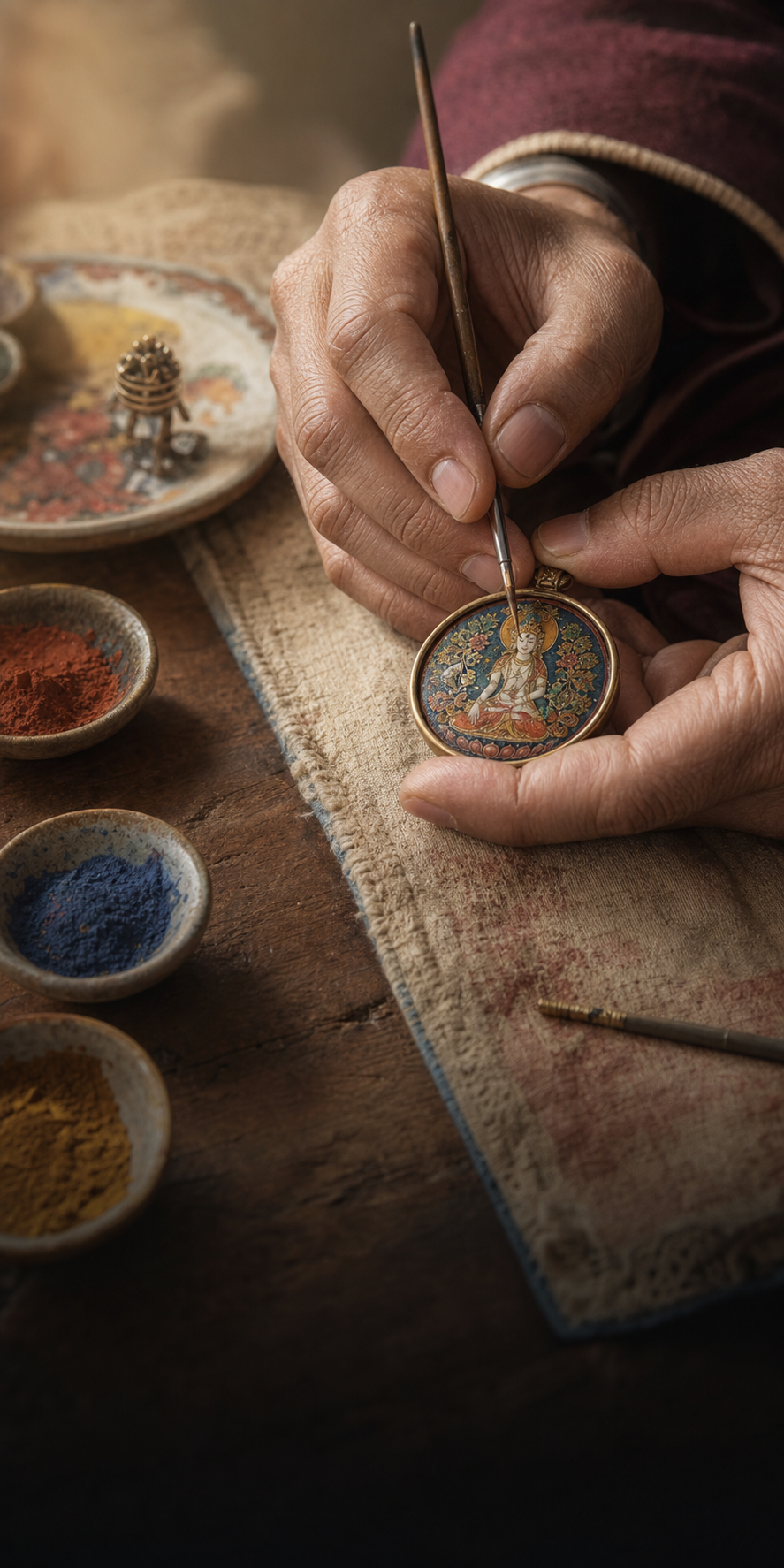
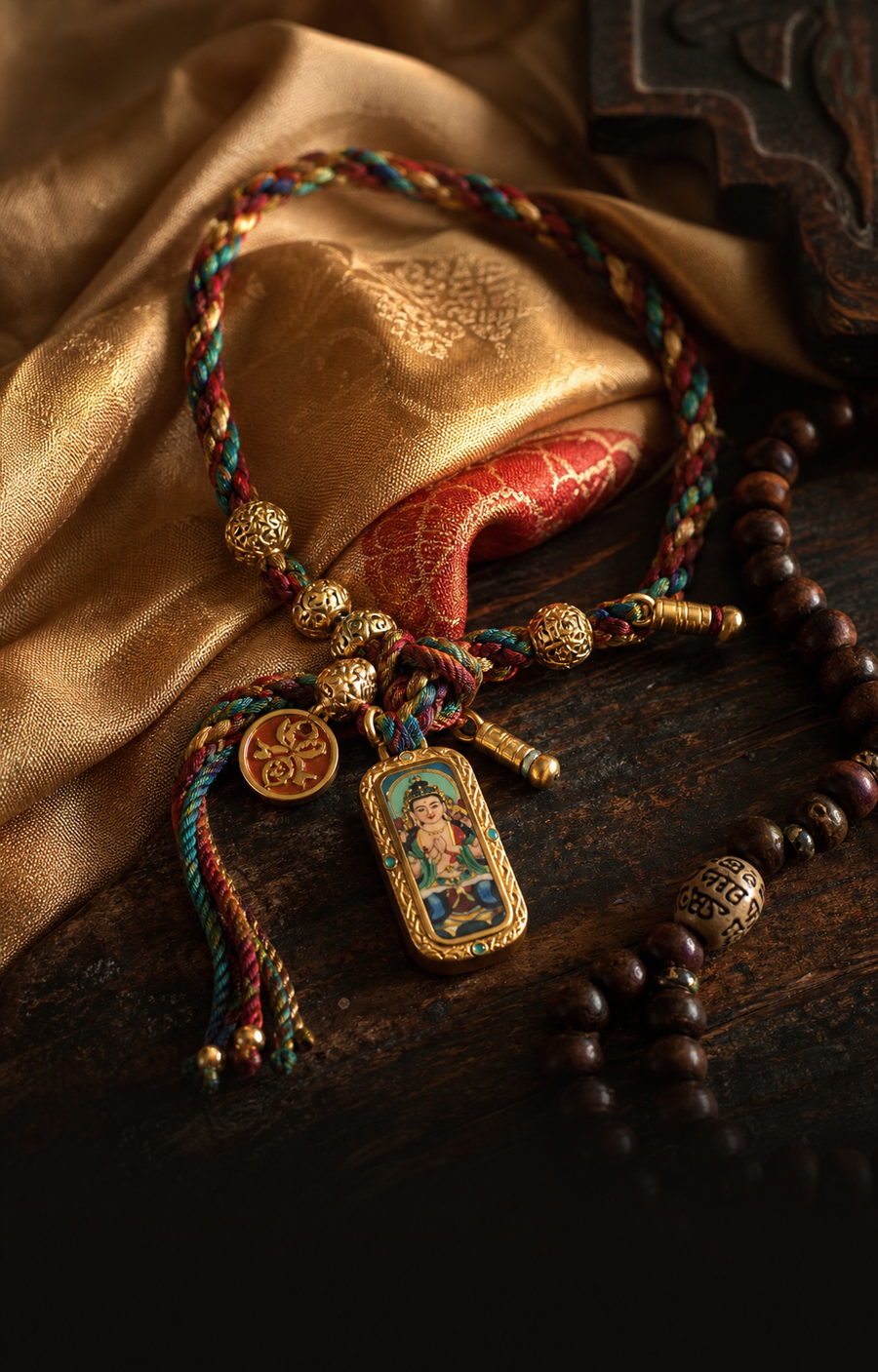
You do not need to be a practicing Buddhist to find meaning in Green Tara. Her central idea — that compassion should be active, and that help should arrive before it is too late — translates easily across traditions. People wear a Green Tara pendant for many reasons: drawn by the artistry, the intricate brushwork, the gold detailing, the quiet drama of that extended foot. Others wear her as a reminder of a turning point — a hard season, a decision that took courage. Some simply like how she looks, and that is valid too.
What Green Tara asks, in her quiet way, is that you show up. Do not wait for perfect conditions. When someone needs you, move. She has been painted a thousand thousand times — on temple walls, on cotton canvas, on tiny pendants meant to hang over a heartbeat. In every version the message is the same: I am here. So are you. Let us begin.
Wear the Symbol
Shop every Green Tara piece
 Handmade Green Tara 3D Relief Pendant$43.99
 Green Tara — Titanium Steel Pendant Necklace (2D)$20.99
 Green Tara — Mini Tibetan Thangka Pendant (2D)$12.99
 Green Tara — Hand-Carved Leather Thangka Pendant (2D)$83.99
 Green Tara — Hand-Painted Thangka Pendant, Full Color (2D)$49.99
 Green Tara — Hand-Painted Gilded Thangka Charm Bracelet (2D)$10.99
 Green Tara — 3D Hand-Painted Tsatsa Relief Thangka Pendant$43.99
 Green Tara — Hand-Painted Tsatsa Thangka Pendant, Deluxe (3D Relief)$49.99